The Best Order to Teach Cursive Letters: Stroke Families
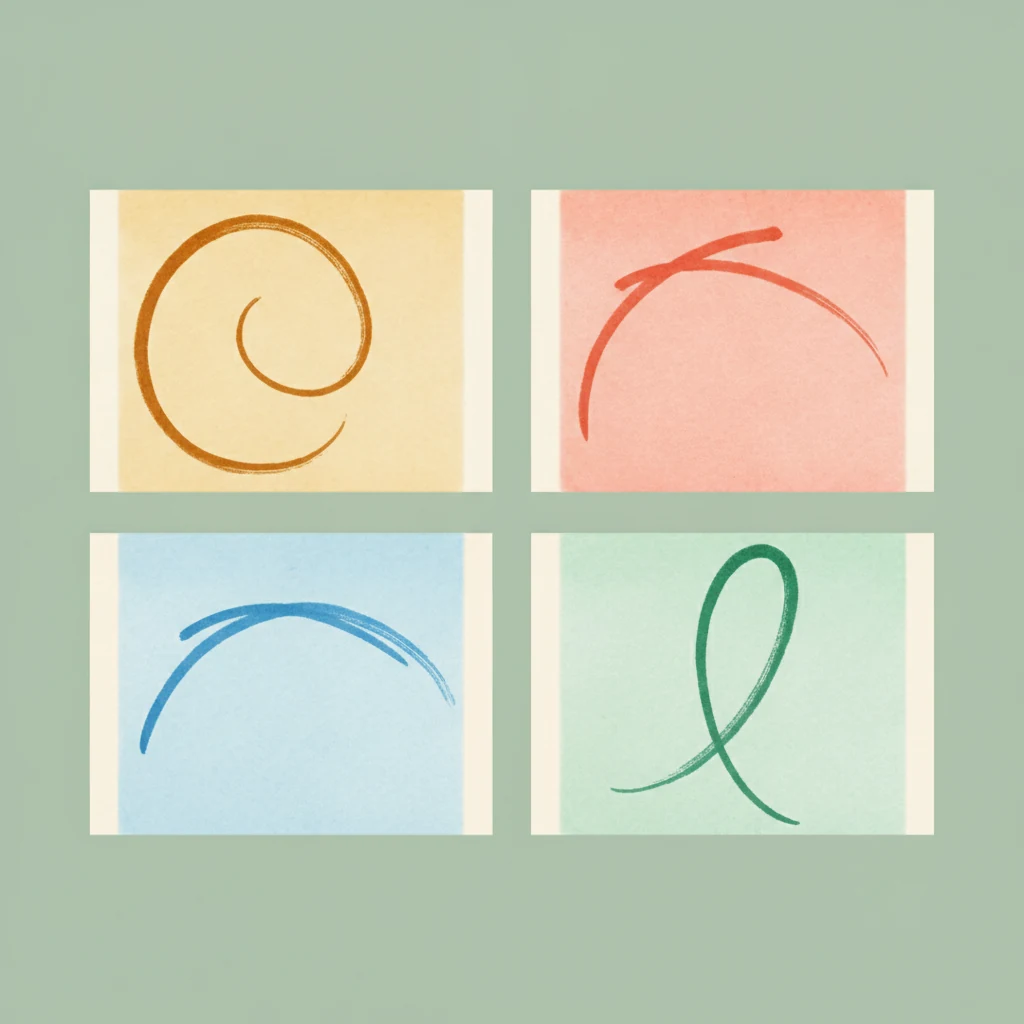
Every parent, every teacher, every handwriting workbook starts the same way: capital A, lowercase a, B, b, C, c. It's the alphabet. It's obvious. And for cursive instruction, it's almost certainly the wrong order.
The reason leading handwriting programs — and the occupational therapists who specialize in handwriting difficulties — don't teach cursive A-to-Z isn't a secret. It's motor learning. When you teach letters in alphabetical order, you're jumping between completely different hand movements with every letter: a is a round counterclockwise stroke, b is an upswing with a loop, c is a round stroke again, d is round-then-tall. The hand never has a chance to build automatic movement patterns before it's asked to do something new.
Group the same 26 letters by how they start — by stroke family — and something different happens. The hand masters one movement at a time. Each new letter in the group reinforces the one before it instead of interrupting it.
The four stroke families
Traditional slanted cursive (the style used in Zaner-Bloser and most US school programs) groups letters by their starting stroke motion. Here's the breakdown, with the rationale for each group.
1 — Downcurve letters
All seven letters begin with the same motion: a counterclockwise curve starting at the 2 o'clock position and swinging down and around. Once a child can make that single entry stroke automatically, the family unlocks together. The differences between c, a, d, and g are just what happens after the round opening — not in the opening itself. Teach the round stroke first; the variations are easy once that motion is muscle memory.
2 — Undercurve letters
These letters all begin with a swing upward from the baseline — a low-to-high entry stroke that's essentially the opposite of the downcurve. Teach this group second because the undercurve connects naturally to the downcurve letters: the exit swing of a c or a is already an undercurve, which is exactly how words string the two families together in connected script.
3 — Overcurve letters
The overcurve is a crest — the pen starts from below the midline, arches up and over, then comes back down. It's the entry stroke for n and m, which share the same hump structure with different repetitions, making them natural to teach together. The less-common letters v, x, y, and z round out the group; by the time a student reaches them, the overcurve motion is already familiar.
4 — Looped letters
These letters all include a distinct loop — either an ascending loop (as in l, h, k, b, f) or a descending loop (as in j and p). Loops are mechanically the trickiest strokes in cursive because they require closing an oval while maintaining the forward motion of the pen. Teaching them last, once the simpler entry strokes are automatic, is standard OT practice.
The teaching sequence in practice
Once you understand the families, the order almost suggests itself:
- Downcurve first. The round family contains some of the most-used letters in English (a, e, o) and gives early wins. Success here builds confidence for the rest.
- Undercurve second. The upswing stroke connects directly to the downcurve exit, so students start building connected script naturally — not as a separate skill.
- Overcurve third. n and m are high-frequency letters, and the overcurve is the bridge between the simpler strokes and the more complex ones.
- Looped letters last. Save the technically demanding loops for when the hand is already fluent with the entry strokes. Most students find them much easier after completing the first three groups than they would have at the start.
This isn't a rigid prescription — if a child needs to learn a specific letter for a project or a name, teach it. But when you're building the cursive foundation from scratch, this order gives the motor system the clearest possible on-ramp.
How to practice one stroke family at a time
Printable Scholar's free cursive worksheet generator lets you enter any text you want — which means you can easily create stroke-family practice sheets rather than being stuck with the alphabet-in-order format of most workbooks.
To practice just the downcurve family, type something like: c a d e g o q ca ad do og. The generator will produce a worksheet with tracing guides and practice lines for exactly those letters, connected as they would appear in running cursive. You can do the same for each family group — it takes about 30 seconds to build a targeted practice set that no standard workbook provides.
For a broader library of print-ready cursive materials, the cursive handwriting practice sheets A–Z page has printable pages for every letter. Once you know the stroke-family sequence, you can pull the specific letters you want and work through them in the right order rather than the alphabetical one.
Build your own stroke-family practice sheets
Generate free cursive worksheets for exactly the letters you're working on — type any combination, get a print-ready PDF.
Before stroke families: the prerequisites
The stroke-family sequence assumes a child is developmentally ready for cursive — and that means a few things are already in place before the first lesson.
A stable grip. Cursive requires sustained, fluid movement, and that's very hard to do with an inefficient grip. If a child is still white-knuckling the pencil or resting the barrel in the wrong finger crook, address the grip before worrying about letter order. The pencil grip guide by age covers the common grip patterns and how to correct each one.
Solid print foundations. Cursive letters are variations on the same strokes used in print — a downcurve in cursive is just a rounder version of the same motion in manuscript. A child who has clear, consistent print habits adapts to cursive faster than one whose print letter formations are still inconsistent. If there's uncertainty about print first, the post on D'Nealian vs. Zaner-Bloser manuscript walks through which print style creates the smoothest path to cursive.
The ability to stay on the line. Cursive's connecting strokes travel along and below the baseline in a specific rhythm. A child who can't yet consistently write on ruled lines will have trouble with the connecting strokes even if the individual letter forms are correct.
Why this matters more now
More than 20 states have passed laws requiring cursive instruction by a specific grade — a reversal from the decade-long trend of dropping it from curricula entirely. For teachers reintroducing cursive after years away from it, and for homeschool parents teaching it for the first time, knowing the stroke-family sequence can mean the difference between a smooth progression and a frustrating one where students seem to forget each letter as soon as they learn the next.
The A-to-Z sequence isn't wrong because the letters are wrong. It's wrong because it treats each letter as its own isolated problem when cursive is actually a system of overlapping movement families. Teach the movement families, and the letters follow naturally.
Frequently asked questions
What age should kids start learning cursive? Most programs introduce cursive in second or third grade, typically after print handwriting is consistent. Developmental readiness — grip stability, line-following, and letter-formation consistency in print — matters more than a specific age.
Does the stroke-family order work for all cursive styles? The four families (downcurve, undercurve, overcurve, looped) apply to traditional slanted cursive, which is what Zaner-Bloser and most US school programs teach. Handwriting Without Tears uses its own groupings — "Magic C" letters and others — with similar underlying logic but different letter assignments. If your curriculum has its own sequence, follow it; the principle of grouping by stroke is what matters.
Should I teach uppercase and lowercase together? Most programs introduce lowercase first — they appear far more often in written text, and the uppercase forms are less consistent in shape across curricula. Master the lowercase families, then layer in the uppercase letters.
My child already knows cursive A–Z. Is it worth resequencing? Probably not. If all the letters are functional, the motor patterns are set. The stroke-family sequence is most useful for initial instruction, not remediation of an already-learned alphabet.